Posts

Showing posts with the label Hadrian

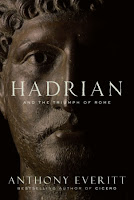
Anthony Everitt's "Hadrian"
Image
Anthony Everitt, who brought us biographies of Cicero and Augustus, has just published a new book about the emperor Hadrian. While I haven't read it yet, I am a great fan of his last two books. Everitt is a conscientious scholar and his portrayal of Cicero was entertaining and intriguing. Augustus was a more shadowy figure and the lack of personal correspondence made his personality very difficult to pin down. I am curious to see how he portrays Hadrian, whose reign is well-documented but whose personal life was difficult to interpret. Read a review of the book in The New Yorker or buy it here.

Apollo of Mantua at Capitoline Museum

Image
On loan to the Capitoline Museum from the Palazzo Ducale in Mantua is the famous marble sculpture of Apollo . This work of art, probably dating back to the time of Hadrian , will be exhibited in Rome until January 6th of 2009. Don't miss the opportunity to see this intriguing antiquity!

Hadrian: Empire and Conflict at the British Museum

Image
Through October 26th, artifacts relating to the emperor Hadrian from 28 museums around the world will be on exhibit at the British Museum . Hadrian, one of the Modern Traveler's favorite emperors, was known for stabilizing the vast borders of the Roman Empire, his great love for Greek culture, his reconstruction of the Pantheon , and his relationship with Antinous, a Greek youth who died in Egypt. So if you find yourself in London (hopefully on your way to Rome!) be sure to visit this very special exhibition.

Day Trips from Rome-Hadrian's Villa at Tivoli

Image
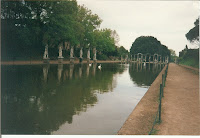
In the 2nd century CE the Emperor Hadrian built a country retreat for himself to escape the chaos and corruption of Rome. Hadrian had travelled all over the Roman Empire and used many different architectural traditions in the more than 30 buildings at the site. Hadrian's Villa was created with extensive horticultural and sculpture gardens, libraries, temples and bath complexes. Today the villa is a UNESCO World Heritage site and still provides a welcome haven for visitors from Rome. While you are in the area of Tivoli (ancient Tibur) be sure to stop at the Villa d'Este , a Renaissance palace known for its spectacular fountains, built by Cardinal Ippolito II d'Este, son of Lucrezia Borgia. For the antiquarians among you, the farm belonging to the Augustan poet Horace is also nearby. The town of Tivoli is about 30 kilometers from Rome. Take the A24 east and turn off at Via Empolitana. Follow the signs to Tivoli, Villa Adriana and Villa d'Este. Alternatively, take the t...

Bernini and the Ponte Sant'Angelo

Image
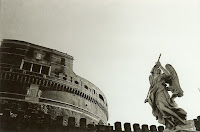
The bridge to the Castel Sant'Angelo (a.k.a. the Mausoleum of Hadrian) is no ordinary bridge. Pope Clement IX asked Gian Lorenzo Bernini , the famous sculptor, to design 10 statues of angels to line the bridge. From Bernini's designs, the pupils in his studio executed the sculptures in 1670. The angels tower over the sides of the bridge at a height of 15 feet. At the foot of each angel is an inscription in Latin. Pictured here is an angel with a lance by Domenico Guidi whose inscription reads: vulnerasti cor meum- "you have wounded my heart." The bridge, open to foot traffic only, was historically the route of pilgrims to St. Peter's. The original bridge was built in the 2nd century CE to provide access to Hadrian's tomb.

"Memoirs of Hadrian" by Marguerite Yourcenar

Image
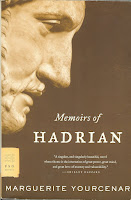
French writer Marguerite Yourcenar devoted the better part of her adult life to researching and writing the Memoirs of Hadrian , published in 1951. While it is fiction, Yourcenar's intimate writing style and painstaking historical accuracy will convince the reader that he is actually reading the journal and letters of the emperor Hadrian. Hadrian was considered one of the "Good Emperors" of the Roman Empire, and Yourcenar's portrayal of him as thoughtful and idealistic reinforces the portrait that history has painted. Most moving are her depictions of Hadrian's personal relationship with Antinous and the misgivings he felt when embarking upon war. Memoirs of Hadrian

The Mystery of the Pantheon

Image
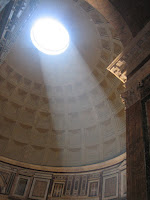
The Pantheon is the most spectacular ancient building in Rome and the eternal favorite of this writer. On a recent trip to Rome I was amazed by the shaft of light shining through the oculus (eye) in the roof which illuminated the circular dome, walls and floor. On dozens of visits in the past to the site this phenomenon has never revealed itself to me, and yet it was very likely the intention of those who designed it 2,000 years ago. In essence, the oculus functions as a grand sundial, by which the ancients could not only count the hours of the day, but also the passage of the seasons. To see it yourself, aim for mid-afternoon on a clear day, when the sun is brightest in the sky.