Posts

Showing posts with the label Churches

The Weirdest Places In Italy
Image
Atlas Obscura , a website devoted to the weirdest places on earth, has an extensive list of curious and extraordinary sites to visit in Italy . On the list are many churches housing the relics of saints, the Capuchin crypt of Santa Maria della Concezione in Rome, Santa Maria Novella Pharmacia in Florence, and the Park of the Monsters in Bomarzo (all places I have mentioned on MoltoItaly). The website offers great information on the history of each site as well as numerous images. It's a great resource for trip planning or for a few minutes' diversion. If you know about a weird and wonderful place in Italy, you can add it to the site too!
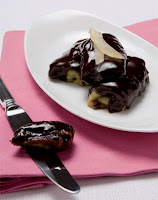
Chocolate Covered Eggplant by the Cathedral

Image
An Amalfi Coast specialty is chocolate covered eggplant: melanzana in salsa di cioccolato . It sounds unusual but some restaurants have been making this dessert for a century. In particular, Da Gemma in Amalfi, with its terrace set back from the main piazza, is truly an Amalfi Coast classic. You'll love the seafood and regional dishes-and the view of the Duomo. Via Fra Gerardo Sasso 11.

The Modern Traveler's Top Amalfi Coast Historical Sites

Image
Not that you need to look for any reasons to visit the Amalfi Coast, but just in case you need some guidance, here are the Modern Traveler's top historical sites to visit on and around the Costiera Amalfitana. 1. Villa Jovis on Capri : Capri is fabled for two reasons. It is breathtakingly gorgeous and it was the playground for the less than moral Emperor Tiberius. Don't miss the ruins of his grand palace, the Villa Jovis, at the southern tip of the island. The flower-lined walk to the Villa from town is a lovely way to spend your morning and the views of the Amalfi Coast will knock your socks off. 2. Paestum (pictured): Somehow this sanctuary of ancient Greek temples was overlooked for the past 2,000 years. The 2,500 year old temples are in almost pristine condition and the rest of the archaeological site is pretty interesting too. Paestum is just a short drive from Salerno which is at the southern base of the Amalfi peninsula. Don't miss the museum ! 3. Herculaneum : In ...

The Best of the Costiera Amalfitana

Image
The Amalfi Coast offers unlimited opportunities for experiencing the best of Italy. For day trips, head to Paestum and Capri. Be sure to visit the 13th century cathedral in Amalfi. For spectacular views don't miss Ravello, a tiny town tucked high in the mountains. Positano offers shopping, beaches and a lively nightlife. From the Amalfi Coast you are in the perfect position to visit Pompeii, Herculaneum and Naples by car or bus. Plan to spend several days in the Costiera Amalfitana-you will fall in love.

Julius Caesar: The Man, The Enterprise, The Myth

Image
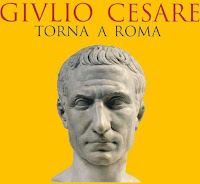
At the Chiostro del Bramante on the Via della Pace, an exhibition of archaeological finds pertaining to the life and achievements of Julius Caesar (" Giulio Cesare. L'uomo, le imprese, il mito" ) will be on display from October 24th to April 5th. More recent works of art, such as paintings by Rubens, will also be shown in this exciting and exclusive exhibit. The Chiostro was designed by the brilliant architect Donato Bramante in the early 16th century is located in the convent and church of Santa Maria della Pace.

More Day Trips from Rome: Orvieto

Image
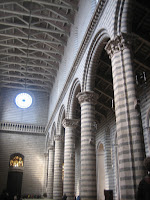
Just 90 minutes from Rome is the hillside medieval town of Orvieto. Once the refuge for popes when Rome was threatened, this tiny town boasts a huge Gothic cathedral. The town is perched on a huge cliff made of volcanic rock and is accessible by tram car. The site has been populated since the time of the Etruscans and there is a museum there devoted to the study of these ancient people. The wines and ceramics of Orvieto are well-known, so be sure to sample both while you are visiting. To get there from Rome take the A1 toward Florence or one of several trains a day that leave from Roma Termini.

Day Trips from Rome: Umbrian Monastery

Image
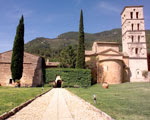
The Wall Street Journal highlights the monastery Abbazia San Pietro in Valle in Umbria . The monastery is refashioned into a rustically simple hotel where you can relax and soak in the gorgeous Italian countryside. While you are there you can explore the ruins of the abandoned medieval village Umbriano , just a short walk away. The monastery also has an exquisite restaurant, Il Cantico , so even if you are not staying the night, be sure to stay for dinner.

Convent Stays in Rome-The Cheapest Lodgings!

Image
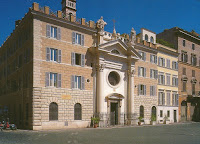
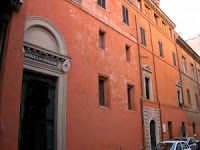
The Church of Santa Susana in Rome maintains an extensive list of convents that accommodate overnight visitors. A convent stay, while very cheap (think 40 euros for a double room) and no doubt picturesque, is not for the luxury traveler. Often there is a curfew and bathrooms are down the hall. But the locations are some of the best in Rome (like the Casa Santa Brigida in the Piazza Farnese, pictured) and obviously the price can't be beat. Visit the Church of Santa Susana website to find the convent that's right for you-and make sure you ask the important questions, like "Is there a curfew?" before you book!

Caravaggio in Rome

Image
It is possible to enjoy the works of the great master Michelangelo Merisi da Caravaggio (the other Michelangelo) without paying museum entrance fees. Three churches house several of the painters works and all are free to visitors. At Santa Maria del Popolo (in Piazza del Popolo ) you can see The Crucifixion of St. Peter and The Conversion of St. Paul. The Church of San Luigi dei Francesi , near Piazza Navona , has three Caravaggios dedicated to St. Matthew. Also next to Piazza Navona is the church of Sant'Augostino whose facade is made of travertine from the Colosseum. Inside you can see the Madonna of the Pilgrims (pictured) , which is remarkable for its realistic portrayal of common people. Caravaggio is known for his heightened use of shadows and light ( chiaroscuro ) and was once a pupil of the great Venetian painter, Titian. At one point, Caravaggio was the most renowned painter in Rome.

The Via Giulia is 500

Image
One of Rome's most elegant streets, the Via Giulia, is celebrating its 500th birthday this summer. The street, built by Pope Julius II, was originally part of a building program around the Vatican. The street runs almost parallel to the Tiber River for a spell, but does not have the traffic of the Lungotevere, the thoroughfare which brings traffic north along the river. The Via Giulia is lined with churches and palazzos-one even belonging to the Medici family. Many of these churches and palazzos, usually closed to the public, will open this summer in celebration of the quincentenary. See the website devoted to the events (unfortunately only in Italian) or read more about the sights on the Via Giulia in a recent New York Times article.

Mausoleum of Costanza

Image
For Roman architecture buffs, there is no better place to experience the excellence of Roman engineering than the Mausoleum of Costanza on the Via Nomentana. The circular temple, built for the emperor Constantine's daughters and later turned into a church, contains a spectacular dome and exquisite mosaics from the 4th century CE. Nearby is the Church of Sant'Agnese which contains extensive catacombs. The mausoleum and catacombs are open daily 9-12 and 2-6, closed Mondays and Sunday and holiday mornings. Be sure to call ahead just in case!

Roman Houses on the Caelian Hill

Image
Under the Basilica of Saints Giovanni and Paolo (John and Paul) are several ancient Roman dwellings purported to be the residences and final resting places of John and Paul , two officers of the court of the Emperor Constantine who were martyred under the rule of the Emperor Julian (361-363 CE). The residential complex is decorated in wall paintings from the 3rd century to 12th century and depict many themes from mythology and early Christian iconography. The site is located not far from the Circus Maximus and the Colosseum and can be visited every day except Tuesday and Wednesday. Once a week the complex is open at night for special tours. Be sure to visit the website to book these tours in advance .

Santa Maria della Concezione-The Height of the Macabre

Image
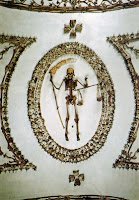
On the Via Veneto is an old Capuchin church built above an underground ossuary (bone depository). The bones of four thousand friars who died in the 17 th through 19 th centuries have been gathered here and arranged in a mad, macabre decorating scheme. Look closely-those are not mosaics but actually human bones. There is also a Caravaggio of St. Francis in the convent, but let's face it, the bones are the draw. The crypt at Santa Maria della Concezione (Via Veneto 27) is open from 9-12 and 3-6 every day except Thursdays.

St. Valentine's Day in Rome

Image
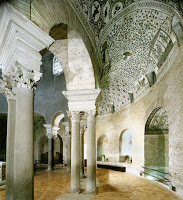
St. Valentine was indeed a Roman, and the best place to spend Valentine's Day is Rome! There are actually two historical figures named St. Valentine who are honored on February 14th by the Catholic Church, both religious men who were martyred under the rule of the emperors. The older St. Valentine was a bishop of Terni (near Rome) and was killed under the emperor Aurelian in 197 CE. He was buried on the Via Flaminia which runs north through the center of Rome and is now the Via del Corso. His relics can be visited at the Basilica of San Valentino in Terni. The later St. Valentine was a Roman priest martyred around 269 CE. He was also buried on the Via Flaminia and his relics are interred at the Basilica of Santa Prassede in Rome located on the Esquiline Hill in the neighborhood of Monti (pictured). The traditional day of St. Valentine coincides with the ancient Roman fertility festival, the Lupercalia, which took place on February 15th.

Tiber Island Attractions

Image
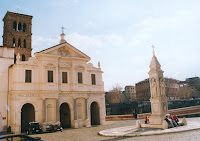
In the middle of the Tiber River is an island once home to a temple to the god of healing, Asklepios. Today the island still is place of medicine, housing a hospital since the 16th century. The relics of Saint Bartholomew who was skinned alive and later became the patron saint of sufferers of skin diseases are actually buried on the island in a church (pictured at right) named for him. The island is more than just a hospital and a church, however. During summer nights there is a cafe with lively music and sometimes a film festival set up on the north end of the island which could provide a diversion on your way to and from Trastevere . There is also a very good restaurant called Sora Lella on the island at Via Ponte Quattro Capi #16.

La Bocca della Verita

Image
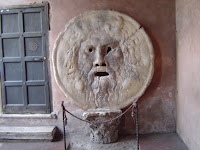
The Mouth of Truth (La Bocca della Verita), made famous by Audrey Hepburn in Roman Holiday , is located in the Greek Orthodox church of Santa Maria in Cosmedin . The church is nestled in the heart of the ancient cattle market, the Forum Boarium. Now this area is a busy spot filled with tourists on their way to the Circus Maximus . The legend is that any liar who puts his hand in the Mouth of Truth will have his hand bitten off! The true story of the Mouth of Truth is that it was probably once a drain cover in this marshy region next to the Tiber which was prone to flooding. The face depicted on the cover belongs to the sea god Oceanus. The church was originally built in the 6th century CE and is named for a quarter in Constantinople, Cosmedin . Be sure to take a peek inside when you visit-you will be amazed by the ancient frescoes and swirling Cosmatesque marble floors.

The Mystery of the Pantheon

Image
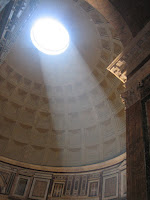
The Pantheon is the most spectacular ancient building in Rome and the eternal favorite of this writer. On a recent trip to Rome I was amazed by the shaft of light shining through the oculus (eye) in the roof which illuminated the circular dome, walls and floor. On dozens of visits in the past to the site this phenomenon has never revealed itself to me, and yet it was very likely the intention of those who designed it 2,000 years ago. In essence, the oculus functions as a grand sundial, by which the ancients could not only count the hours of the day, but also the passage of the seasons. To see it yourself, aim for mid-afternoon on a clear day, when the sun is brightest in the sky.